
Hoe de digitale omgeving en kunstmatige intelligentie de manier waarop we denken, leren en ons gevoel van eigenwaarde ontwikkelen, veranderen.
If I asked you what you last saw on your phone, you would probably remember at least roughly. If I asked what you had seen over the past 20 minutes, the task would already be more difficult. I am sure you saw a lot. A message. A video. A news story. An advert. A photograph of someone you know. A photograph of someone you do not know, yet you somehow know where they went on holiday. Then another video. And another.
The digital environment gives us extraordinary access to information, people and opportunities. But it also presents the brain with a relatively new problem: never before has so much content competed so persistently for our attention. And with the rise of artificial intelligence, the question is no longer only, ‘What am I paying attention to?’ A second one appears: Which tasks am I still keeping for myself?
Attention is not an unlimited resource
Our brains constantly receive information from both the external and internal environment. Sounds, images, smells, touch, bodily sensations, thoughts and emotions. Conscious awareness, however, can work with only a small part of all this. Attention is a process of selection. It determines which information reaches deeper processing and which remains in the background. And there is something important here. Conscious processing is expensive. It requires effort, time and energy. When we are doing complex tasks, we do not usually perform several of them fully at the same time. More often, we switch between them. Sometimes so quickly that it feels like multitasking. But each switch has a cost.
Automatic processes are different. They are fast and economical, and several can run in parallel. Because of them, we do not consider every individual step while walking, or start from scratch each time we unlock the front door. The brain likes automation simply because brain activity is expensive.
The problem begins when processes about which we would prefer to make conscious decisions gradually become automatic. We reach for the phone without deciding to. We open an app without knowing why. Fifteen minutes later, we are still there, but we struggle to say exactly what we gained from it.
Social media does not wait for our attention.
Our attention is particularly easy to direct towards something new, intense, surprising or potentially dangerous. This is a useful system. If something suddenly changes in the environment, it is good for the brain to notice. The same mechanism, however, also responds to rapid visual change, a categorical headline, conflict, a notification or a video that begins before we have decided whether we want to watch it. Social media platforms are exceptionally good at delivering a stream of signals that the brain registers as important. Novelty. Emotion. Social comparison. A possible threat. A reward. Then novelty again. Not every piece of content needs to be interesting. It is enough that the next one might be.
So we receive a great deal of stimulation, but relatively little information remains in long-term memory. The fatigue is real, even when we were supposedly ‘just relaxing’ with our phones.
There is something else. Content is becoming shorter and shorter, but this does not necessarily mean it requires fewer resources. Quite the opposite. The constant change forces the brain to repeatedly adjust to a new context. A face. A subject. A sound. A message. An emotion. Rest is not always rest simply because it does not look like work.
Then AI arrived
If social media says, ‘Give me your attention’, large language models can very easily become something else: ‘Give me your tasks.’
This is not necessarily a bad thing. Artificial intelligence can save us an enormous amount of unnecessary effort. Searching for the correct format. Translating mechanically. Organising information. Beginning a routine task from a blank page. Spending time on an activity from which we learn nothing and where human involvement adds little real value. But there is a difference between unnecessary effort and developmental effort.
Developmental effort is what it takes to understand a new principle. To formulate an argument. To compare alternatives using our own criteria. To check whether something is true. To choose a position. To create something that carries our experience, judgement and point of view. The brain naturally looks for a faster and more economical way to solve a problem. But learning does not happen in the complete absence of effort. It needs moderate difficulty, feedback and a sense of progress.
The question, therefore, is not whether we use AI. It is what we use it for and at which stage we introduce it.
There are two small clarifications. Although neither is really that small.
First, a language model begins with our prompt. With the way we have framed the problem. With the information we have chosen to include. With the perspective we have already established.
Second, we are not neutral towards the answer either.
The brain more readily searches for, accepts and remembers information that fits our existing expectations. Arguments that confirm us sound reasonable. Those that contradict us can easily appear weak, extreme or poorly expressed. This is confirmation bias. It is not merely an error in logic. It often helps us avoid unpleasant dissonance and preserve a positive view of ourselves. Now add a social environment made up of people with similar positions, an algorithm that learns from our previous behaviour, and an AI tool to which we pose questions from our own perspective.
This is how an echo chamber develops.
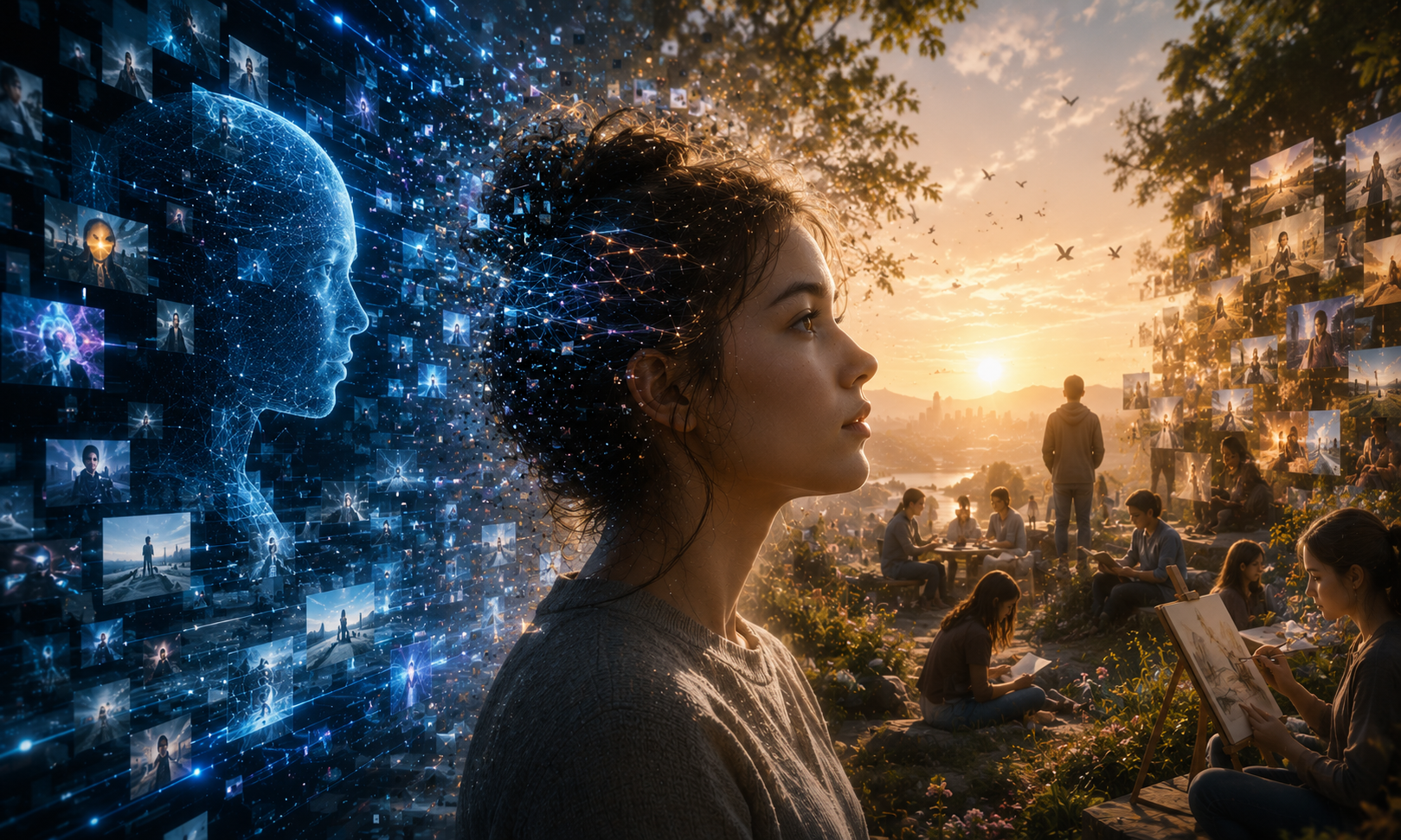
No one needs to hide the other point of view from us. Sometimes it is enough to see the same message repeatedly. The more familiar it becomes, the more easily we begin to experience it as true. What we see often gradually begins to tell us who we are. The digital environment does not influence only our attention and opinions. It also participates in the development of identity.
What do I see often? What do I begin to accept as normal? Who do I compare myself with? How do I evaluate myself? What do I show in return?
This is a cycle, not a one-way process.
The online environment creates unwritten norms for appearance, success, relationships, parenting, productivity, rest and even mental health. We do not simply observe them. We begin to position ourselves in relation to them. Then we choose what to show. What we show receives a reaction. In this way, some parts of us begin to occupy more and more space, while others gradually remain outside the frame.
Humans have always used symbols to communicate belonging and identity. Once, this might have been an object associated with the role of a hunter. Today, it might be a particular brand of water, an item of clothing, a book, a sports watch or a carefully arranged desk. Symbols are not a problem in themselves. The problem arises when the prop replaces the experience.
We can buy everything that looks like self-care without actually caring for our bodies or minds. We can publish ideas that sound like our own without having done the thinking behind them. We can build a convincing story about ourselves that does not match the life we have actually experienced.
And one part of us knows this.
The mismatch between the identity we present and the experience we genuinely have creates tension. Sometimes we call it anxiety. Sometimes dissatisfaction. Sometimes we simply feel that something is wrong, even though from the outside everything looks exactly as it should.
Mental health cannot be measured only in screen time
It would be easy to end this discussion with a recommendation to spend less time on our phones. But ‘less’ does not answer all the important questions.
What are we doing online? When? What state are we in before we begin? How do we feel afterwards? Are we creating, learning or speaking with someone close to us? Or are we automatically scrolling through content that leaves us more tense, more tired and less satisfied with ourselves?
The same two hours in front of a screen can have entirely different effects.
Technology is not inherently bad for our mental health. It can support learning, relationships, access to help, creativity and a sense of community. It is a tool. And with any tool, the manner, purpose and context of its use matter most.